

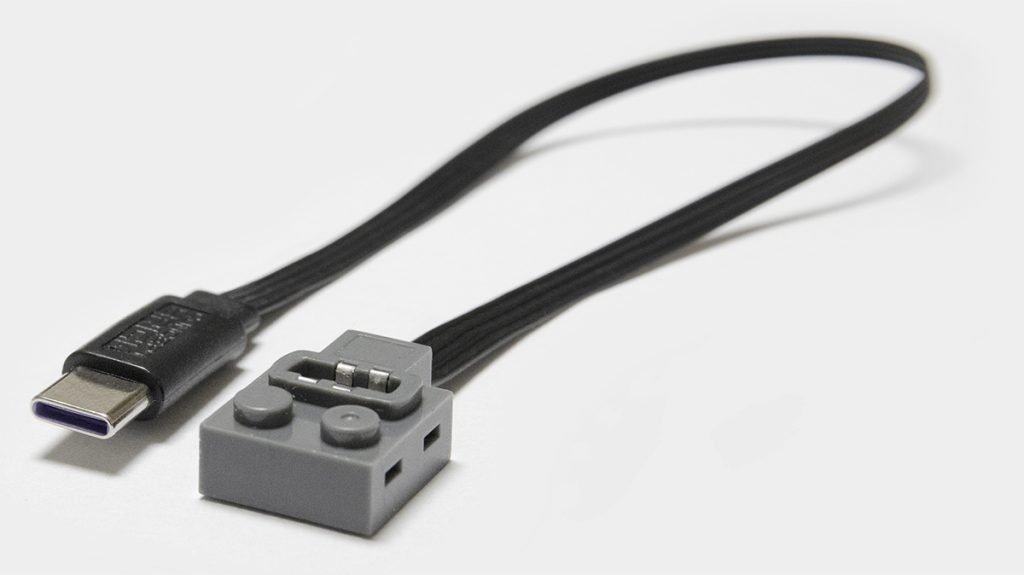
When we started working on a TypeC to Power Functions adapter, the first question was actually very basic:
Should this be a battery product, or should it just convert modern TypeC power into something Power Functions can use?
At the beginning, both directions looked reasonable.
A rechargeable battery box sounds attractive. It is portable, self-contained, and familiar to LEGO Technic users. But after looking at the real use cases, especially display models and MOCs that run indoors, the battery box idea started to feel less practical.
A lot of builders already have TypeC chargers on the desk. They already have power banks. They already have long TypeC cables. Some people even have TypeC power strips near their workbench or display shelf.
So why force another dedicated battery into the system?
That became the main reason we moved toward a TypeC adapter.
The goal was not to replace every LEGO Power Functions battery box. For portable models, batteries still make sense. If someone is driving a Technic truck outside, a cable is obviously not ideal.
But for a lot of real Technic use, the model is not moving around freely.
Examples:
• GBC modules
• display models
• motorized cranes
• test rigs
• gearboxes on a workbench
• Technic MOCs used for filming
• static models with moving functions
For these cases, continuous power is usually more useful than portability.
The next challenge was voltage.
Power Functions is basically a 9V system, while TypeC can mean many different things depending on the charger, cable, and negotiation method. A simple cable is not enough if the goal is reliability. Some cheap solutions may make the motor spin, but they do not always behave consistently under load.
During early tests, we saw this very clearly.
One charger worked fine. Another charger caused a reset when the motor started. A power bank ran a small M motor without any issue but struggled when an XL motor started under load. The same adapter could feel stable on one setup and unreliable on another.
That was the point where the project stopped being just a connector project.
It became a power stability project.
We decided the adapter needed regulated 9V output. Not because we wanted to make the motors faster, but because we wanted the behavior to stay predictable across different TypeC power sources.
There is a big difference between “the motor spins” and “the model runs properly.”
A Technic MOC with multiple functions needs predictable power. Steering should not twitch. Motors should not slow down randomly. A GBC module should not change timing after running for half an hour. A crane should not behave differently just because the user changed the USB charger.
Another thing we had to think about was size.
If the adapter is too bulky, it becomes annoying to use in real LEGO Technic builds. If it is too small, heat management and cable strength become harder. We spent more time than expected on that balance. The adapter had to be small enough to hide inside or near a model, but not so small that it felt fragile.
This is one of those details that does not sound important until you actually plug and unplug prototypes dozens of times.
The connector also matters.
Power Functions plugs were not designed around modernTypeC usage. Builders pull, bend, route, and hide cables in many different ways. A weak cable exit would become a problem quickly. So the mechanical side of the product ended up being almost as important as the electrical side.
In the end, the design direction became pretty clear:
Use the power source people already have, regulate it properly, and make the adapter simple enough that builders do not need to think about it.
That is what this TypeC to LEGO Power Functions adapter is trying to do.
It is not a high-power modification kit. It is not meant to push motors beyond their normal use. It is simply a cleaner way to power older PF motors in modern building environments.
And honestly, that is why we still like the idea.
Power Functions is old, but it is not useless. Many builders still have motors, switches, lights, extension wires, and IR receivers from that system. The parts are still useful. The weak point is often just the power source.
TypeC gives those parts a more practical life in current Technic and MOC building.
That was the real reason we built this adapter.
Not to make something flashy.
Just to make old Power Functions hardware easier to use again.
LEGO® and Power Functions are trademarks of the LEGO Group. This adapter is an independent compatible accessory and is not sponsored, authorized, or endorsed by the LEGO Group.