

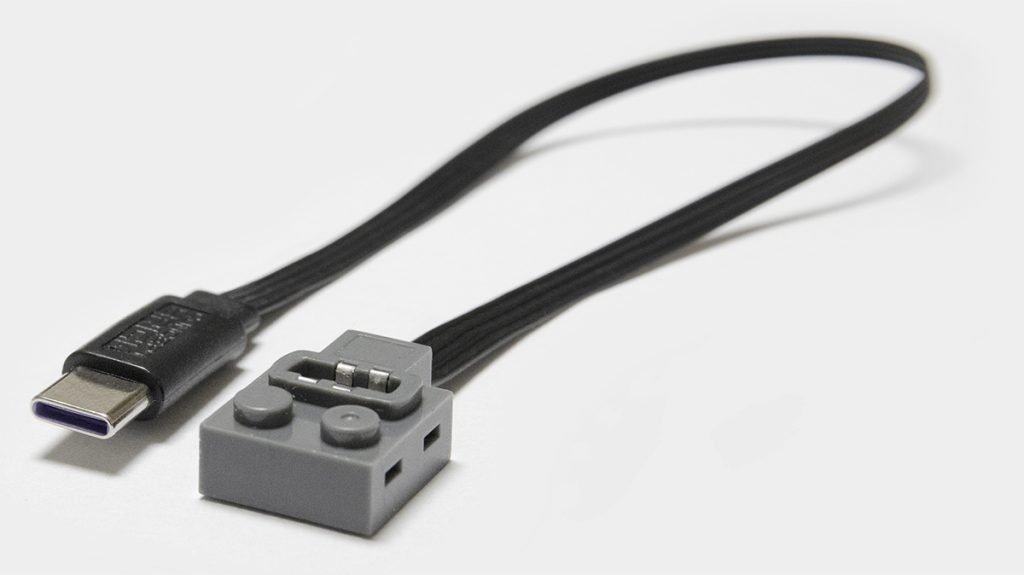
When people look at a TypeC to LEGO Power Functions adapter, they usually see a small cable-like accessory.
From the outside, it does not look like much.
But the important part is not the shape. The important part is how the adapter handles power.
That was the main focus during development.
Power Functions motors expect a 9V-style environment. Old LEGO battery boxes provide that in a simple way. Not perfect, but predictable enough for the original system. TypeC, on the other hand, is more flexible but also more complicated.
A TypeC charger might provide 5V, 9V, 12V, 15V, or 20V depending on the device and negotiation. Some power banks behave differently depending on load. Some chargers shut down quickly when they detect a sudden current spike. Some low-quality cables create voltage drop.
So we had to make a decision early:
Do we rely on the USB source to behave correctly, or do we control the output ourselves?
We chose to control the output.
That is why the adapter is designed around regulated 9V output for Power Functions-compatible use.
This was not just a specification decision. It came from testing.
In early prototypes, unregulated or weakly regulated designs could work in simple cases. A small motor would spin. A light model would move. For a quick demo, it looked fine.
But once we connected heavier Technic MOCs, the weak points became obvious.
Motor speed changed more than expected. Startup behavior was inconsistent. Some power banks worked only with certain motor combinations. Servo motors were not always clean. Larger models made the whole system feel less predictable.
The problem was not that TypeC lacked power.
The problem was that the adapter needed to deliver the right kind of power for Power Functions.
Stable power matters because Technic models are mechanical systems. Small changes in motor behavior can change how the whole model feels.
A crane rotation mechanism needs smooth movement. A crawler needs predictable torque. A GBC module needs timing consistency. A display model should run the same after 40 minutes as it did in the first minute.
This is why we cared about 9V regulation.
A lot of builders think about power only when the motor stops. But in testing, we found that bad power can affect a model before it fully fails. The motor may run, but not well. The build may work, but not consistently.
That kind of problem is annoying because it is hard to diagnose.
A builder may rebuild a gearbox, change gears, replace a motor, or blame friction, when the real issue is unstable power delivery.
We wanted the adapter to remove that variable.
Of course, regulated 9V output does not solve every problem.
If the model is overloaded, the motor will still struggle. If the drivetrain has too much friction, it still needs mechanical improvement. If too many motors are started at once from a weak power source, there are still limits.
But with a stable adapter, troubleshooting becomes cleaner.
You can look at the model itself instead of wondering whether the power source is changing behavior.
Another design concern was compatibility with existing Power Functions-style parts.
Many builders still use PF motors, lights, switches, extension cables, IR receivers, and third-party compatible parts. The adapter needed to fit naturally into that ecosystem. It should not require a new controller, special battery, or unusual setup.
That is why we kept the product simple from the user side.
TypeC in.
Power Functions-compatible output.
Stable 9V.
No extra app. No charging routine. No special battery maintenance.
From a development point of view, this simplicity is actually the hard part.
The user should not need to understand USB negotiation, voltage drop, startup current, or charger behavior. The adapter should handle as much of that as possible.
That is the kind of product we wanted to build.
Not a flashy electronics module.
Just a reliable bridge between modern TypeC power and older LEGO Technic Power Functions builds.
The more we tested it, the more we realized that this small bridge is useful.
Power Functions is still popular because it is simple, physical, and easy to integrate into MOCs. TypeC is popular because it is everywhere. Bringing the two together in a stable way makes a lot of sense.
Especially for builders who want their models to run for a long time without constantly replacing or charging AA batteries.
That is the real value of the adapter.
Not more complexity.
Less frustration.
LEGO® and Power Functions are trademarks of the LEGO Group. This adapter is an independent compatible accessory and is not sponsored, authorized, or endorsed by the LEGO Group.