

Developing a TypeC Power Adapter for LEGO Technic and Power Functions MOCs

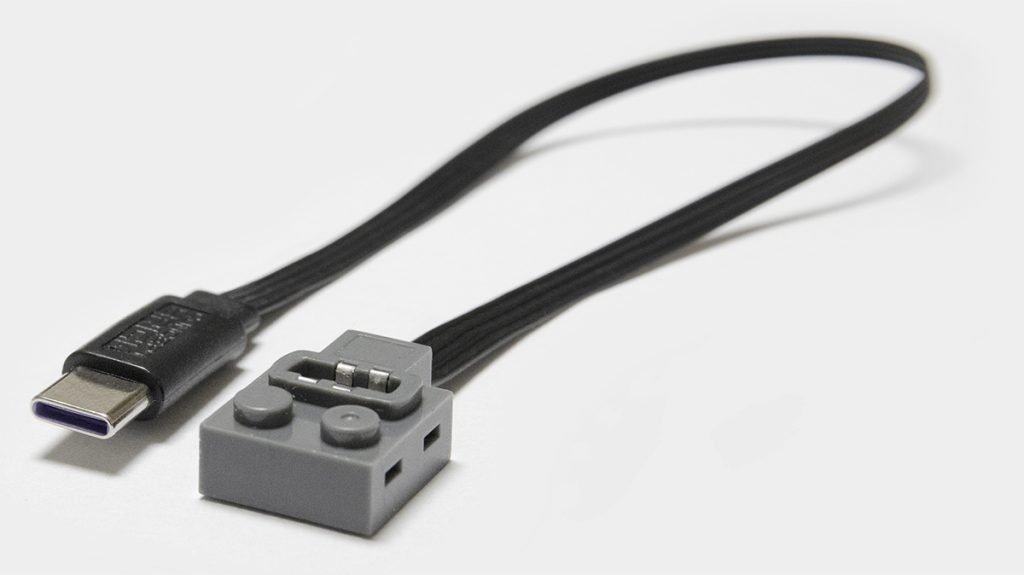
When we first started working on a TypeC power adapter for LEGO Power Functions, the idea looked simple enough.
Take TypeC input, output 9V, connect it to a Power Functions plug, and make the motor run.
That was the simple version in our head.
The real version was more annoying.
The first prototypes did make PF motors spin, but that alone didn’t mean the design was good. A single motor on the desk is not a real test. Most Technic builders do not use one motor under perfect conditions. They use drive motors, steering motors, gearboxes, turntables, linear actuators, and sometimes several motors starting at almost the same time.
That is where the problems started to show up.
Some USB chargers handled the load well. Some power banks shut down for a split second. Some setups worked fine with an M motor but behaved badly with an XL motor. A few chargers looked fine on paper but produced unstable behavior when the motor was under sudden load.
This is one of those things that sounds small until you actually test it on a real LEGO Technic MOC.
A Technic vehicle on a stand is easy. A crawler pushing against the floor is different. A crane lifting weight is different. A GBC module running continuously for an hour is different again.
The main issue was not simply voltage. It was how the whole system behaved during load changes.
Power Functions motors are old, but they are not bad motors. They respond very clearly to the quality of the power source. With weak or unstable power, the motor may still run, but the model does not feel right. Steering becomes less predictable. Speed changes under load. Multiple functions starting together can cause a brief dip that is easy to miss unless you are looking for it.
That is why we decided not to make a very basic USB cable.
A simple cable would have been cheaper. It would also have been easier to explain. But it would depend too much on the charger, the cable, the power bank, and the exact motor combination used by the builder.
For a product like this, that is not good enough.
So the design direction became clear: the adapter needed to provide regulated 9V output, not just pass through whatever the USB source happened to provide.
The goal was not to make LEGO motors faster. That was never the point. The goal was to make them behave more consistently.
During testing, stable 9V output made a noticeable difference in larger Technic builds. The motors started more predictably. Servo behavior was cleaner. Speed variation was reduced. The system felt closer to a fresh battery box, but without the slow decline as batteries discharged.
Another design point was size.
A lot of LEGO-compatible electronics become too bulky once you add protection circuits, connectors, casing, and strain relief. For Technic MOCs, size matters. The adapter should not look like a random electronics module hanging off the side of the model. It should be small enough to hide behind panels, under a chassis, or inside a display base.
At the same time, making it too small can create other problems. Heat dissipation becomes worse. The cable exit becomes weaker. The connector becomes harder to handle. So there was a balance between making it compact and making it durable enough for repeated use.
We also spent time thinking about the type of user.
Some builders want to keep everything fully original, and that is fine. This adapter is not really for them.
The adapter is more for people building:
Technic display models, GBC modules, motorized MOCs, test rigs, custom machines, or models that run indoors for long periods.
For those use cases, AA battery boxes are not always ideal. They are simple, but they are not convenient for long runtime. Rechargeable batteries help, but they still need charging, replacing, and maintaining. TypeC is already everywhere. Most people already have power banks, wall chargers, and desk chargers.
From a development point of view, that was the strongest reason to use USB-C.
We were not trying to create another battery ecosystem. We wanted to let builders use the power sources they already own.
The hardest part was making that feel reliable enough for LEGO Power Functions hardware.
After several revisions, the product became less about “TypeC to PF” and more about making old PF motors easier to use in modern setups.
That may sound like a small difference, but it changed the whole design.
A cable makes a connection.
A proper adapter has to manage the behavior between two different systems.
That was the real engineering work behind this product.
Note: LEGO and Power Functions are trademarks of the LEGO Group. This adapter is an independent compatible accessory and is not an official LEGO product.